
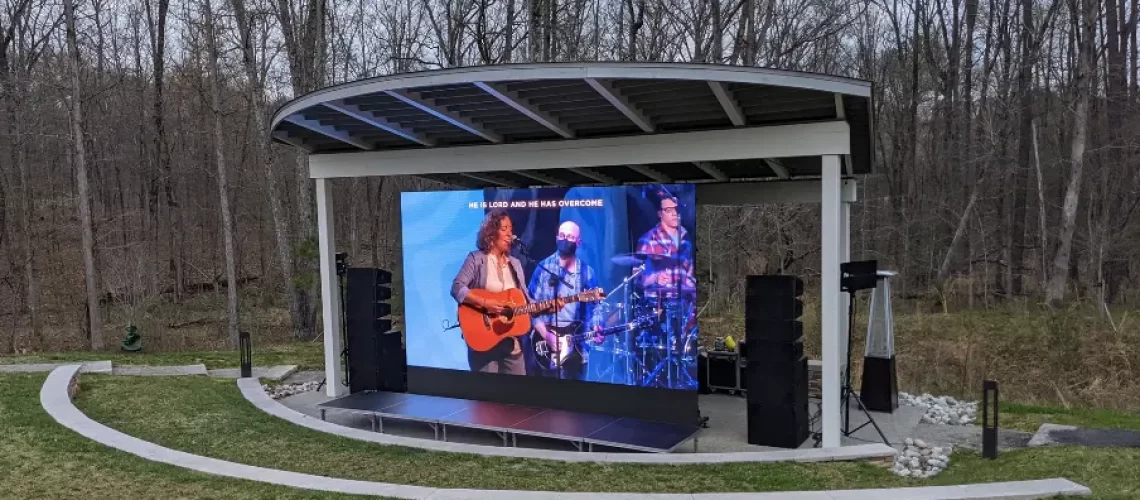
Does your event need an HDTV, Projector, or LED Video Wall for video content?
Whatever event you’re planning- corporate meeting, music festival, product launch, trade show- one of the most critical decisions you’ll make in event production is choosing the right display technology for your video content. Your team may have spent countless hours designing graphics and editing videos, but if it’s not displayed clearly, brightly, and with the right technology, your audience may miss the message entirely.
In today’s production world, there are three primary visual display technologies used at events: HDTV displays, projectors, and LED video walls. Each has its advantages and limitations depending on the venue, audience size, content type, and budget. There are strengths to all of them, as well as best use cases for each one. Here’s some guidance so you can make the right call choosing the right display technology:
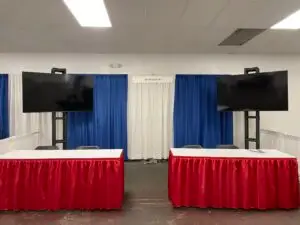
1. HDTV Displays: Small and Mighty
What They Are
HDTV displays (also known as TVs) are flat-panel screens that range in size from under 30 inches to as large as 115 inches. In the event world, they are often mounted on stands, wall-mounted, or integrated into custom scenic setups.
Advantages
- Convenient Size & Portability: HDTVs are ideal for small breakout rooms, digital signage, or as confidence monitors for speakers. They’re lightweight, easy to transport, and fast to set up or strike.
- Bright Enough for Indoor Use: Most modern TVs are designed with brightness and contrast that allow them to look great in well-lit indoor rooms. You don’t need to worry about dimming overhead lights.
- Simple Connectivity: Many TVs feature wireless casting, HDMI, and USB inputs. While wireless connections are handy, it’s best to use a hardwired input for high-stakes presentations to avoid lag or dropouts.
Limitations
- Size Cap: TVs max out around 115 inches, which makes them suitable for small audiences- think 5 to 50 people. Beyond that, viewers in the back may struggle to see clearly.
- Not Outdoor Friendly: Standard HDTVs are not built for the elements. Most rental companies don’t carry weather-resistant outdoor-rated models. Even a breeze can knock over an unsecured TV stand!
- Limited Viewing Angle and Impact: While fine for close-up use, TVs don’t carry the visual impact needed for large or dynamic environments.
When to Use an HDTV Display
- Breakout sessions or small meetings
- Trade show booths with 1:1 or 1:5 engagement
- Lobby signage or registration kiosks
- Speaker confidence monitors on stage
2. Projectors and Screens: Versatile and Cost-Effective
What They Are
Projection systems pair a digital projector with a screen (or a projection surface such as a wall or custom backdrop). They come in a wide variety of brightness levels (measured in lumens) and screen sizes.
Advantages
- Cost-Effective for Large Images: Projection remains one of the most budget-friendly ways to create a large-scale image. You can project a 20-foot-wide image for a fraction of the cost of a comparably sized LED wall.
- Creative Flexibility: You can project onto non-traditional surfaces such as building facades, scenic elements, or translucent screens to create immersive effects.
- High Resolution for Less: Projectors can output high-resolution imagery (1080p or 4K) on large screens without requiring a massive investment.
Limitations
- Ambient Light Interference: The biggest downside to projection is that it loses brightness in environments with a lot of ambient light. Overhead lights or windows can wash out the image.
- Not Ideal for Outdoors: Even the brightest projectors struggle to compete with daylight. Most projection screens are made of fabric, which can rip or degrade in wind or rain.
- Space Requirements: Rear-projection setups need room behind the screen. Front-projection setups need careful consideration of sight lines and projector placement.
When to Use Projection
- Indoor general sessions with controlled lighting
- Corporate meetings in hotel ballrooms
- Non-traditional creative uses (projection mapping, scenic effects)
- Budget-conscious large-format needs
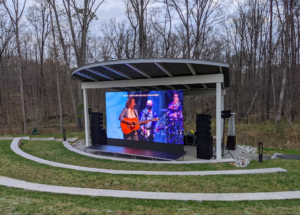
3. LED Video Walls: Bright and Bold
What They Are
LED video walls are made by assembling multiple LED panels into a seamless display. Each panel contains LEDs that emit light directly, meaning these displays remain bright even in full sunlight. They vary in resolution depending on their pixel pitch, which is the distance between each pixel.
Advantages
- Bright Enough for Any Environment: LED walls are the best option for bright rooms, direct sunlight, and outdoor events. Many outdoor-rated panels can shine at 4,000+ nits of brightness.
- Scalable and Seamless: Want a 10-foot-wide display? 20 feet? 100 feet? You can go bigger- all you’ve got to do is add more panels. The modular nature of LED walls allows for massive, attention-grabbing screens.
- Durability and Weather Resistance: Outdoor-rated LED panels are built to withstand the elements, including rain and wind, making them the best solution for festivals, sporting events, and rallies.
- Immersive Experience: With low pixel pitch (e.g., 1.9mm or 2.6mm), you get a super crisp image, even for audiences up close. This is ideal for high-resolution content with small text or detailed graphics.
Limitations
- Cost: LED video walls are the most expensive display option. High-res, low-pixel-pitch panels command a premium rental rate, especially for larger walls. It costs to look good.
- Rigging or Ground Support Required: LED panels need to be safely mounted. That means hanging from venue rigging points or building a ground support structure, and both require skilled labor and time. This is not the place to try and cut corners.
- Power Needs: Compared to a projector or HDTV, LED walls demand significantly more electrical power, which can affect load-in logistics and venue requirements.
- Resolution Depends on Pixel Pitch and Size: Choosing the wrong pixel pitch can lead to low visual fidelity. For example, large pixel pitches (e.g., 4.8mm) may cause logos or fine text to look jagged or unclear.
When to Use an LED Video Wall
- Outdoor concerts, festivals, or movie nights
- Trade shows with high foot traffic and bright lights
- High-profile indoor productions where wow-factor matters
- Events with detailed visual content, such as product demos or real-time data
- Anywhere brightness and visual clarity are top priority
Decision-Making Factors: How to choose right one for you
Now that we’ve broken down each option, let’s get to choosing the right display technology. How do you do it? Here are some guiding questions:
1. What’s the Size of the Audience?
- Small (Under 50 people): A single HDTV or a few strategically placed displays may be enough.
- Medium (50–300 people): Projection is a cost-effective option, especially if you can control the light.
- Large (300+ or arena-sized): LED video walls provide the size, brightness, and impact needed.
2. Is the Event Indoors or Outdoors?
- Indoors with controllable lighting: Projection and HDTVs work well.
- Indoors with high ambient light: LED walls are best.
- Outdoors (daytime): Only LED walls (with high brightness and weather-rated panels) will perform.
- Outdoors (nighttime): Projection may work if weather allows, but LED walls remain the safest bet.
3. What Are the Ceiling and Rigging Capabilities?
- Low Ceilings or No Rigging: HDTVs and ground-supported projection screens are better.
- High Ceilings or Rigging Points Available: LED walls can be flown for a clean, elevated look.
- No rigging allowed or limited space?: Ground-support LED walls or portable TV carts are options.
4. What’s in Your Presentation?
- Large text and bold images: All technologies will perform reasonably well.
- Detailed graphics, spreadsheets, fine print: Go for high-resolution projection or low pixel-pitch LED.
- Live video feeds or real-time interaction: LED walls provide the sharpness and responsiveness needed.
5. What’s Your Budget?
- Tight Budget: HDTVs or mid-brightness projectors are your friends.
- Moderate Budget: High-lumen projectors and creative screen use offer solid value.
- Premium Budget: LED video walls will provide the most impactful and flexible solution.
Pro Tips from the Production Team
- Don’t Rely on Wireless Connections for Key Presentations: Whether you’re using a TV, projector, or LED wall, always hardwire critical devices. Wireless casting is handy for quick setups but unreliable for high-pressure content.
- Think About Sightlines: Make sure all attendees can see the screen. A screen that’s too small or too low can make attendees disengage. Raise the screens and scale content appropriately.
- Use the Right Content Format: Match your content to the technology. For example, if you’re using an LED wall, ensure your graphics are designed for its resolution and pixel pitch to avoid blurriness or misalignment.
- Always Plan for Power: Especially with LED walls, make sure your venue has enough power circuits to support the technology safely. Your AV company should help with this.
- Consider Backup Options: For mission-critical events, consider a secondary display system or confidence monitors to avoid downtime in case of failure.
Choosing the right display technology is more than just picking the biggest or brightest option. It’s about understanding the unique demands of your event and aligning them with the right technology.
Still not sure what’s best for your event? Let us help. Our team has years of experience producing events of all sizes and can guide you to the best visual solution based on your goals, venue, and budget. Reach out to us for a free consultation.