
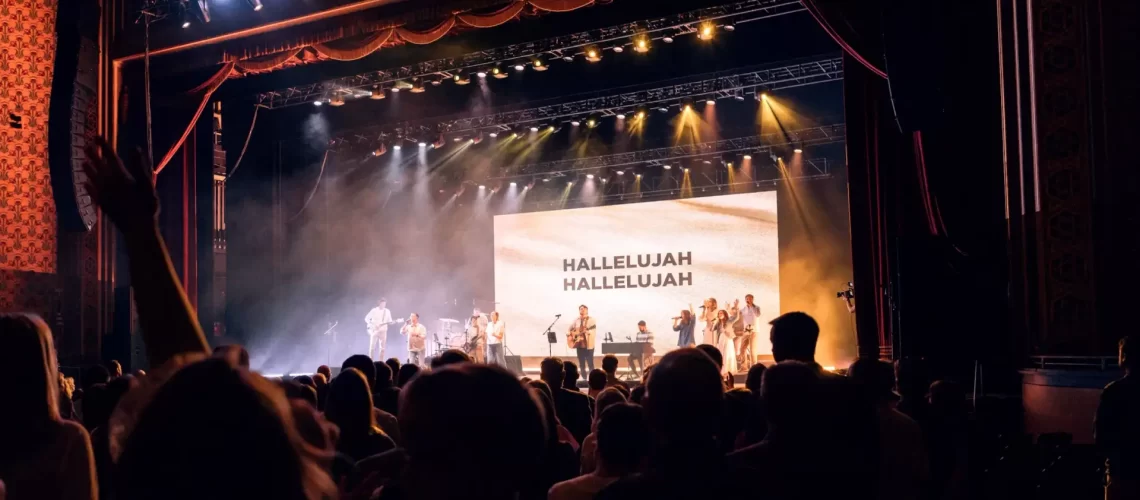
In our work with our houses of worship, we’ve seen a lot of limitations that those customers find themselves up against when it comes to technology. The good news is: we’re in the business of finding AV solutions for houses of worship, whether you have 30 or 3000 attendees.
Here are some of the most common AV headaches we’ve seen houses of worship and churches experience:
1. The band is different every week and so is your sound volunteer– making consistency in mixing difficult
When you’re largely relying on volunteers to run the technical side of things, you’re grateful for their time- but it also makes it hard to keep a consistent sound on a week-to-week basis when it feels like you’re starting from scratch every week. Throw in an ever-changing band and a guest speaker or two with different cadences, tones, and volumes, and you’ve got yourself a real rollercoaster when it comes to getting things to a solid baseline.
Try this:
Implementing a consistent digital mixing console with pre-set scenes can make a huge difference. You can give your volunteers a solid starting point by storing different templates for common setups (e.g., full band, acoustic worship, guest speaker only). Pair this with some basic training and cheat sheets for your tech team, and you’re in business.
Another option is to consider scheduling a professional sound tech to dial in your presets once, then relying on volunteers to simply recall and tweak them week-to-week.
2. You want to implement a livestream, but you don’t know where to start (and how to make it look and sound good)
Providing a way for people to join virtually because of distance, illness, or circumstance is a noble cause, but configuring it well is another feat entirely. Choosing the camera, connecting it to your system, and ensuring everything connects, uploads, and streams in real time can feel daunting.
Try this:
Start simple! One camera, a clean audio feed from your mixing console, and a reliable encoder or computer running OBS (Open Broadcaster Software) can be the starting point you need. If your budget allows, consider investing in a PTZ (pan-tilt-zoom) camera that gives you professional flexibility with minimal operators.
Also, don’t underestimate the importance of audio in a livestream. Bad video is forgivable, but bad sound will make people tune out fast. An AV technician can help ensure your board is feeding clean, balanced sound into your stream. Often, a separate “broadcast mix” can help ensure what your online viewers hear is just as good as what’s happening in the room.
3. Your pastor’s vision and your budget aren’t lining up and you don’t know what equipment upgrades to prioritize
We get it: when there’s a lot of “wow”, sometimes there’s a lack of “how”. Your leadership has big visions for your space and its capabilities, but the budget is only allowing for one step at a time. It’s hard to know where to start and what to prioritize when everything feels like it could use some upgrading.
Try this:
Start with a technical audit of your existing equipment. A professional assessment can help you identify what’s working, what’s failing, and what’s holding you back. From there, you can prioritize upgrades that make the biggest difference. These are things like audio clarity, microphone reliability, visual display, or signal routing.
Think in phases! Not everything has to happen at once. For example, upgrading your speakers might be more critical than replacing your projector, or investing in a proper mixing console might improve both in-room and livestream quality. An integrator can help you design a roadmap that aligns with your leadership’s vision and your financial reality.
4. You want to go bigger for special services and events, but you don’t know what extra production is worth the money
A special service or event likely means new people will be experiencing your space for the first time. You want to not only establish a good first impression with them but create a memorable experience for members, too. But how do you know what’s actually worth the money?
Try this:
Focus on impact over flash. What’s the experience you want your congregation to have? What moments should stand out?
Sometimes, subtle additions like intelligent lighting or a haze machine for atmosphere can really elevate the experience without breaking the bank. Start by outlining your goals for the event, then partner with a production company to help scale your ideas to your budget. Temporary upgrades can often be rented, tried, and tested to make sure it’s what you’re looking for. Then, you can confidently know what you’d like to invest in.
5. You’re having trouble determining which equipment to rent and which equipment to buy
When it comes to AV equipment, it’s easy to fall into one of two traps: either overspending on gear that will sit unused for most of the year, or constantly renting the same gear and losing money over time.
Try this:
Ask yourself two questions:
How often will we use this?
Do we have the people to set it up and run it properly?
If the answer to both is “regularly” and “yes,” it might make sense to invest in the equipment. But if the gear is only needed for 2-3 events per year — and requires specialized setup or programming — renting might be the smarter move.
It also helps to think modularly. For example, buying a good digital mixer that works for weekly services, but can also scale for larger events by adding rented input/output boxes or speakers. That way, your investment stretches further, and you stay flexible.
The good news: we can help with all of this!
You don’t have to navigate technical challenges alone. We can help with full system design, a one-time training session, or troubleshooting a livestream hiccup. We’re here to help you move forward with confidence and clarity!